🍃
By Daniel, an ESL Educator, Idiom Series Author, and a Curious Guide
🍃
Act One: Wonder
Why would we call something bad a blessing? Why do we sometimes call a setback “a blessing” even though it feels like bad news at first? How can something that seems like a disaster end up being good for us? This contradiction is what makes the idiom so interesting to explore.
🍃
Act Two: The Picture
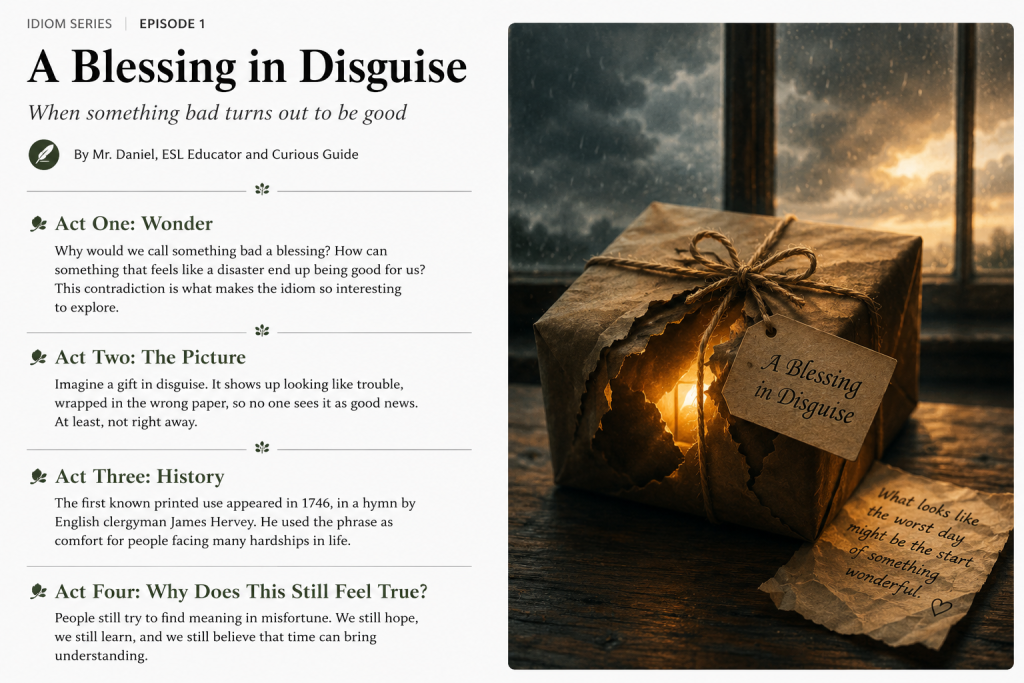
Imagine a gift in disguise. It shows up looking like trouble, wrapped in the wrong paper and addressed in unfamiliar handwriting, so no one sees it as good news. At least, not right away.
But who really needed to hear these words?
It wasn’t the person who first said them. It was the person who heard them and felt a bit of relief inside.
Maybe it was a grieving mother, a bankrupt merchant, or a soldier writing home. Or someone whose crops had failed again, standing in a field that felt like it had turned against them, needing just one honest sentence that didn’t hide the truth but still offered hope.
Those are the people who needed this phrase. Not a historian. A person in pain.
🍃
Act Three: History
This is the point where the story receives both a name and a date.
The first known printed use appeared in 1746, in a hymn by the English clergyman James Hervey. He wrote about a “blessing in disguise” as a form of religious comfort, using words meant for moments like these. At a time when infant mortality, crop failure, and disease were common, people needed a way to hold on to their faith without ignoring their sorrow. Hervey offered them four words that managed to do both.
Now I care, because this is more than just a phrase. A real person once offered these words to people who were struggling, and enough of them found hope that the phrase is still shared from person to person, even three centuries later.
🍃
Act Four: Why Does This Still Feel True?
People still try to find meaning in misfortune. We lose jobs, relationships, and plans, and we still look for the silver lining afterward, even if we are not religious.
People still hope. They still grieve. They recover, turn failure into opportunity, comfort each other after loss, and trust that time will bring understanding.
If this saying vanished tomorrow, English would still have other ways to talk about good luck and bad luck. What we would lose is smaller but maybe more valuable. We would lose a reminder that people before us faced the same questions we do. Why do bad things happen? Can suffering mean something? Should we stop hoping?
This small phrase has carried their answer for almost three hundred years. It does not explain suffering, but it does not accept that suffering always wins.
The phrase does not say “this isn’t bad.” It says, “This is bad, and it might still matter.”
🍃
A Final Reflection
Most people no longer turn to a hymnal when facing hard times, but we still use phrases like “blessings in disguise.” That’s because human nature hasn’t changed as much as we might think. Tough times feel just as hard now as they did in an 18th-century village or during a modern layoff.
Maybe that’s why this expression has lasted so long. It isn’t really about blessings or disguises. It’s a quiet, stubborn refusal, handed down through grieving mothers, bankrupt merchants, and people standing in ruined fields, to let the worst day be the final word.
That story shows why the idiom has lasted. Now, let’s look at how to use it in everyday conversation.
…
Now Let’s Learn It: The ESL Lesson
How It Is Used Today
The phrase started as a religious way to explain suffering, but now people use it for any disappointment that turns out okay. People usually say it when looking back, and it sounds informal and conversational, not like something you’d see in a report.
🍃
Common mistake: Learners often use this phrase when something is still unresolved. Saying “I hope this is a blessing in disguise” is correct. But saying “This is a blessing in disguise” while the problem is still happening usually isn’t.
🍃
Formal vs. informal: This idiom belongs in conversation. In formal writing, you’d more likely say “what initially appeared to be a setback ultimately proved beneficial.”
🍃
Dialogue Example
Harper: I still can’t believe I lost that job last year.
Lucas: I know it was really hard at the time.
Harper: But honestly, looking back—it was a blessing in
disguise.
Lucas: Really? How so?
Harper: If I hadn’t lost it, I never would have found this new
position. I’m so much happier now.
🍃
Synonyms & Related Expressions
- Every cloud has a silver lining. This saying means there is hope that something good will come after something bad. “After the store closed down, she found a better job across town—every cloud has a silver lining.”
- Things happen for a reason. This is a broader and more philosophical way to look at events. “Losing that apartment was heartbreaking, but things happen for a reason—the next one was twice as nice.”
- What doesn’t kill you makes you stronger. This saying focuses on how people can grow through hardship. “The first year of running the business was brutal, but what doesn’t kill you makes you stronger.”
🍃
Common Real-Life Situations
- Losing your job helps you find a better career. “After getting laid off, she finally pursued the career she’d always wanted—it turned out to be a blessing in disguise.”
- Having your flight canceled helps you avoid a bigger problem later. “His flight was canceled, and he missed the storm that grounded every plane for two days—a true blessing in disguise.”
- Going through a breakup leads you to a healthier relationship. “She was devastated when the relationship ended, but a year later she realized it was a blessing in disguise.”
- Getting sick makes you change your lifestyle for the better. “Being diagnosed with high blood pressure was a blessing in disguise—it made him finally take his health seriously.”
- Having your college application rejected helps you find a school that fits you better. “Getting rejected from her first-choice school turned out to be a blessing in disguise; the school she attended was a much better fit.”
🍃
Practice Exercises
Exercise 1: Complete the Sentences
- Getting rejected from my dream job turned out to be a ______ ______ because I found something even better.
- The flat tire was a blessing in disguise—it made us stop and notice the ______ ______ that we would have missed.
- Losing the contract felt terrible at first, but it was a blessing in ______ since our team found a much bigger client.
- Maybe this injury is a blessing in disguise; it’s forcing me to finally take ______ ______.
- Her strict teacher seemed harsh in school, but years later she realized it was a ______ in disguise.
Answers:
- blessing in disguise
- beautiful view (or any reasonable two-word answer describing something worth seeing)
- disguise
- better care (or any reasonable two-word answer, e.g., “more rest,” “time off”)
- blessing
Exercise 2: Multiple-Choice Questions
- “A blessing in disguise” is typically used:
a) While something bad is currently happening
b) After a difficult situation turns out to have a good result
c) To describe something obviously good from the start
d) Only in formal academic writing - Which sentence uses the idiom correctly?
a) I think losing my keys today is a blessing in disguise; we’ll see.
b) She is a blessing in disguise every morning.
c) Missing that flight turned out to be a blessing in disguise—she used the extra day to land a job interview she would have missed.
d) The blessing disguised itself in the room. - The idiom most likely originated from:
a) A 20th-century advertising slogan
b) An 18th-century religious hymn
c) A Shakespeare play
d) A sailor’s superstition - Which word pair best fits the idiom’s structure?
a) blessing / curse
b) luck / fortune
c) gift / wrapping
d) blessing / disguise
Answers:
- b
- c
- b
- d
Exercise 3: Error Corrections
- “I hope this disguise blessing helps me in the future.” (fix the word order)
- “This was blessing in disguise.” (add the missing article)
- “It is a blessing in disguise right now while it’s happening.” (fix the verb tense issue)
- “He blessing-in-disguised his whole life.” (rewrite correctly — this is not a verb)
- “A blessing on disguise changed everything.” (fix the incorrect preposition)
Answers:
- “I hope this blessing in disguise helps me in the future.”
- “This was a blessing in disguise.”
- “It turned out to be a blessing in disguise.” (or any correct past tense version)
- “Looking back, his whole life was a blessing in disguise.”
- “A blessing in disguise changed everything.”
Exercise 4: Fill in the Blanks with Context
- Maria missed her flight—which turned out to be a ______, since that flight was later delayed for ten hours.
- Losing the championship game was hard, but the coach said it was a ______ that pushed the team to train harder.
- My roommate moving out felt awful at first, but it was a ______ because I finally got my own space.
- The factory’s closing devastated the town, yet many now call it a ______ that brought new industries.
- Failing the exam once felt like the end of the world, but it became a ______ that taught me how to truly study.
Answers:
- blessing in disguise
- blessing in disguise
- blessing in disguise
- blessing in disguise
- blessing in disguise
Exercise 5: True or False Questions
- “A blessing in disguise” can only be used about religious events.
- The idiom is normally used to describe something while it’s still happening.
- The phrase originated in a religious hymn from the 1700s.
- “Every cloud has a silver lining” expresses a similar idea.
- The idiom is appropriate for highly formal legal documents.
Answers:
- False
- False
- True
- True
- False
Exercise 6: Write Your Own Example
Reflect on a personal experience that initially seemed negative but ultimately resulted in a positive outcome. In two or three sentences, describe the event and incorporate the idiom in a natural manner.
🍃
Bibliography & Additional Resources
- Hervey, James. Meditations and Contemplations, 1746.
- Merriam-Webster Dictionary, entry: “blessing in disguise”
- The Phrase Finder, phrase origin database
- Oxford English Dictionary, historical usage citations
🍃
Author’s Note
I love this idiom because it describes something most of us have experienced—the slow realization that a painful moment ended up meaning more than the hurt itself. If you have your own “blessing in disguise” story, I’d really like to hear it.
Coming up next: “A Dime a Dozen.”
Remember: Every word has a story. Stay curious.
🍃
If you enjoyed this story, you might also like:
- A Dime a Dozen
- A Picture is Worth a Thousand Words
- Actions Speak Louder Than Words
- Add Insult to Injury
- All Ears