By Daniel, an ESL Educator, Idiom Series Author, and a Curious Guide
🍃
Act One: Wonder
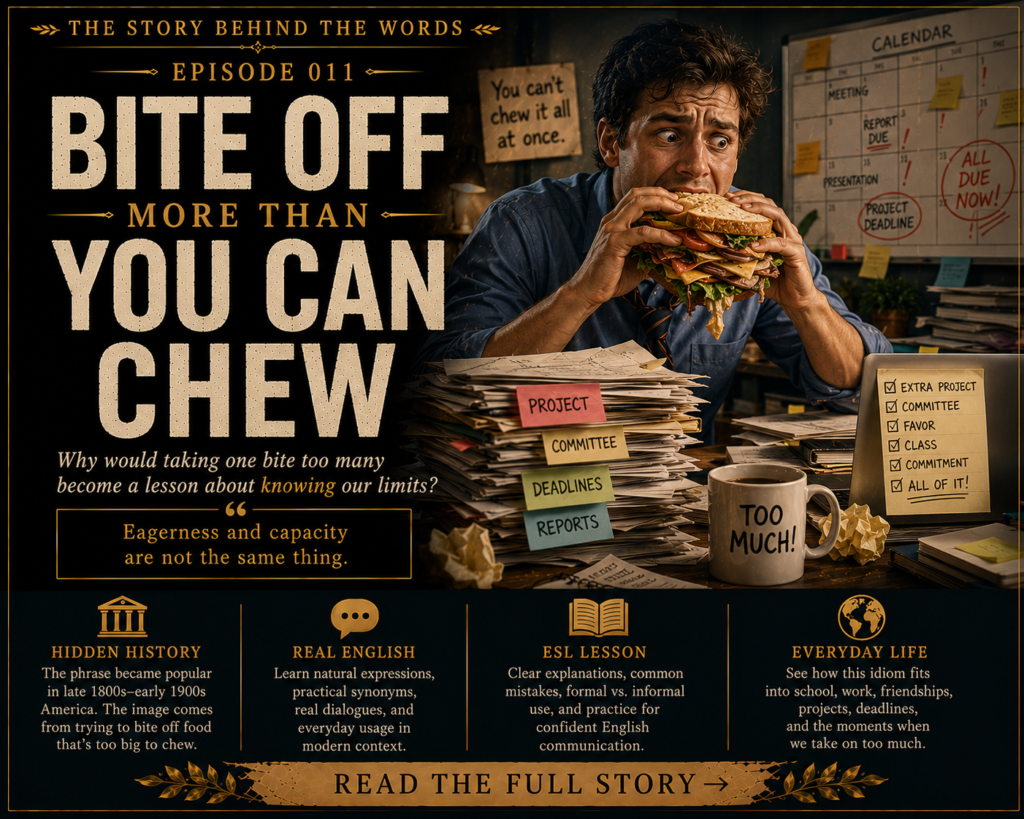
Why would taking one bite too many become a lesson about knowing our limits?
🍃
Act Two: The Picture
Imagine someone starting a new semester, a new job, or a new year. Their calendar is wide open, and everything feels possible. They say yes to the extra project, the committee, the favor, the class they don’t need, and the commitment they’re unsure about. They agree to it all, because right then, anything appears within reach.
Three weeks later, all of it is due at once.
But who actually needed to hear this?
Not the person who set boundaries and protected their time. It was the one who said yes to everything and now found themselves overwhelmed by too many deadlines, too many promises, and not enough hours. This was someone who truly wanted to do it all, but was only now realizing, too late, the gap between what they hoped for and what they could actually handle.
Think of a student juggling five extracurriculars, two part-time jobs, and a full course load. Or an employee who took on three projects to prove themselves, but now can’t do any of them well. Or a volunteer who joined every committee and is now backing out of everything, apologizing.
Those are the people who needed this phrase. They learned the hard way that eagerness and capacity are not the same thing, and they needed a clear way to describe what happened before they could begin fixing it.
🍃
Act Three: History
The phrase is usually seen as an American saying that became popular in the late 1800s and early 1900s. The literal image is clear: trying to bite off a piece of food, like meat, bread, or chewing tobacco, that’s so big you can’t chew it easily. Your mouth is full, you can’t move anything, and you’re stuck. It’s uncomfortable and even a bit silly.
People started using this image as a metaphor because the comparison fits so well. Biting off more than you can chew and taking on more than you can handle feel much the same. Once you’ve committed, you can’t just undo it, and you end up in a tough, overwhelming spot that you created yourself.
This saying shows a mix of American practicality and self-awareness. It’s not meant to point out other people’s mistakes. Instead, it’s for those honest moments when someone realizes they’ve taken on too much. The funny image of a mouth that’s too full and a jaw that can’t do anything makes the admission feel less harsh.
🍃
Act Four: Why Does This Still Feel True?
The pressure to say yes is stronger than ever, but our ability to do everything still hasn’t kept pace with the expectation that we should try.
Modern life gives us more chances to overcommit than people in the past ever faced. Emails come in at any hour. Projects stretch across time zones. Social plans stack up on top of work. Our culture praises doing more, being more, and taking on more, but it rarely stops to ask if the person saying yes can actually do it all well.
We keep taking on too much because we want to help, impress others, or truly think we can handle it this time. But partway through, we realize we were wrong. Eventually, we reach that time when our calendar is packed, and our energy is gone, and the only honest thing to say is: I bit off more than I could chew.
If this phrase disappeared tomorrow, we’d still have expressions like “overcommitted” and “in over your head.” But we’d lose the physical feeling it gives—the instant picture of a mouth too full to work. That image does what abstract words can’t: it makes you feel overcommitted before you even finish reading.
🍃
A Final Reckoning
This idiom feels curiously comforting. It doesn’t call someone foolish or say they were wrong for wanting to do everything. Instead, it just describes what happened in a way so familiar and human that you might even smile a bit, even if the situation isn’t funny.
Most people who bite off more than they can chew do it because they care. They wanted to help and contribute. They believed in themselves, maybe somewhat more than the facts supported. That’s not a character flaw. It’s a common kind of optimism, and this phrase, at its best, describes it with gentleness instead of judgment.
The lesson isn’t to avoid risks. It’s to understand how much you’re taking on before you start.
That story explains why the idiom has stuck around. Next, let’s see how you can use it in daily conversation.
…
Now Let’s Learn It: The ESL Lesson
How It Is Used Today
The phrase “bite off more than you can chew” describes a situation where someone takes on more work, responsibility, or commitment than they can manage. People use it as a warning, a gentle comment, or even to think about their own actions. The mood might be caring, a bit teasing, or simply concerned, depending on who is speaking and their relationship.
🍃
Common mistake: Learners sometimes use this phrase for any hard task, even if someone is handling it well. But the idiom is really about overcommitment, or taking on too much, not just doing something difficult. If someone is successfully managing a tough project, that is not biting off more than they can chew. The phrase is used when someone takes on more than they can realistically handle.
🍃
Formal vs. informal: This phrase is considered informal to semi-formal. It works well in conversations, when giving personal advice, or in casual work situations. For formal writing or professional reports, you would probably employ phrases like “the scope of the project exceeded available resources” or “the workload proved unsustainable.” Still, the idiom can show up in semi-formal settings, such as coaching sessions, advice columns, or professional mentoring.
🍃
Dialogue Example
Nina: I’m in three clubs, I’m tutoring two classmates, and I still have to finish my science project.
Eli: You’re starting to bite off more than you can chew.
Nina: I know, but I wanted to do everything.
Eli: It’s okay to say no to some things.
Nina: You’re right. I should focus on what I can actually finish.
Eli: Then you won’t feel totally overwhelmed.
🍃
Synonyms & Related Expressions
- Take on too much. This means accepting more tasks, responsibilities, or commitments than you have time, energy, or ability to manage well. “She realized halfway through the semester that she had taken on too much—four advanced courses, a part-time job, and a leadership role in a campus organization.”
- Overextend oneself. This means going beyond your available time, energy, or capacity, often by taking on too much at once. “He had a habit of overextending himself every spring, agreeing to every opportunity that came along and then collapsing under the weight of them by May.”
- Overcommit. This means promising more than you can realistically deliver, often because you are enthusiastic, want to help, or find it hard to say no. “The team overcommitted to three client proposals in the same week, and none of them received the attention they deserved.”
- In over one’s head. This means being in a situation that is too difficult, complex, or demanding for your current skills or resources. “Two months into the project, it was clear he was in over his head—the technical requirements were well beyond what he had trained for.”
- Overestimate one’s ability. This means believing you can do more, or do it better, than is actually possible in a given situation. “She had overestimated her ability to manage the renovation while working full time. By week three, both the house and the job were suffering.”
🍃
Common Real-Life Situations
- When a student takes on too many classes or activities at once. “By October, she was exhausted and falling behind in every course. She had bitten off more than she could chew when she registered for six classes and joined three clubs.”
- When an employee agrees to lead several projects at the same time. “He said yes to everything his manager asked and quickly realized he had bitten off more than he could chew. The quality of every project was declining because his attention was spread too thin.”
- When a person volunteers for too many events or responsibilities. “She had offered to organize the fundraiser, coordinate the school trip, and manage the newsletter all in the same month. By week two, even she admitted she had bitten off more than she could chew.”
- When someone starts a large project without enough time or resources. “They decided to renovate the entire house before the holidays and quickly discovered they had bitten off more than they could chew. The kitchen alone took three weeks longer than expected.”
- When someone realizes they have made more promises than they can keep. “He had told four different people he would help them move on the same weekend and had to call each of them to explain that he had bitten off more than he could chew.”
🍃
Practice Exercises
Exercise 1: Complete the Sentences
- She agreed to plan the entire conference by herself and quickly realized she had ________ ________ ________ ________ ________ ________ ________.
- “I signed up for five online courses this month.” “That sounds like you might be ________ off more than you can ________.”
- He took on three freelance projects alongside his full-time job and admitted after two weeks that he had ________ ________ ________ ________ ________ ________ ________.
- “I thought I could manage it all.” “It happens to everyone — sometimes we bite off __________ ________ ________ ________ without realizing it.”
- The new business owner tried to handle accounting, marketing, and customer service alone and eventually had to hire help — she had clearly ________ off ________ ________ ________ ________ chew.
Answers:
- bitten/off/more/than/she/could/chew
- biting/chew
- bitten/off/more/than/he/could/chew
- more/than/we/can/chew
- bitten/more/than/she/could
🍃
Exercise 2: Multiple-Choice Questions
- “Bite off more than you can chew” is best used when:
a) Someone attempts a task that is genuinely difficult but still within their ability
b) Someone takes on more work or responsibility than they can realistically manage
c) Someone refuses to help with a project because they are too busy
d) Someone completes a large project successfully after working very hard - Which sentence uses the idiom correctly?
a) “She bit off more than she could chew when she chose the spicy option at the restaurant.”
b) “He bit off more than he could chew, so he finished all his work ahead of schedule.”
c) “After agreeing to lead the project, write the report, and train the new staff all in the same week, she admitted she had bitten off more than she could chew.”
d) “They bit off more than they could chew because the task was very interesting.” - The phrase “bite off more than you can chew” most likely originated from:
a) Late 19th and early 20th-century American speech, based on the literal image of biting off too large a piece of food
b) 18th-century British naval language about taking on too many crew members
c) Ancient Greek philosophy about moderation and self-knowledge
d) A medieval European proverb about farming and the dangers of planting too many crops - Which situation best illustrates the idiom?
a) A student who carefully chooses three manageable courses and completes them with high grades
b) An athlete who trains very hard for one competition and wins
c) A freelance writer who accepts twelve article commissions due in the same week and can only finish four of them properly
d) A manager who delegates tasks efficiently and finishes a project on time
Answers:
- b
- c
- a
- c
🍃
Exercise 3: Error Correction
- “She bite off more than she can chew with that project.” (fix the verb tense)
- “He has bitten off more than he can chewed.” (fix the verb form)
- “They are biting off more than they could chewing.” (fix the verb form)
- “Don’t bite more off than you can chew.” (fix the word order)
- “I think she has bitten off more than she could chew at the job.” (The sentence is almost correct — remove the unnecessary preposition at the end)
Answers:
- “She bit off more than she could chew with that project.”
- “He has bitten off more than he can chew.”
- “They are biting off more than they can chew.”
- “Don’t bite off more than you can chew.”
- “I think she has bitten off more than she could chew.”
🍃
Exercise 4: Fill in the Blanks with Context
- “How is the new role going?” “Honestly, I think I’ve ________ ________ ________ ________ ________ ________ ________ — I didn’t realize how many responsibilities came with it.“
- The volunteer coordinator warned new members not to ________ ________ ________ ________ ________ ________ ________ in their first month, no matter how enthusiastic they felt.
- She had promised to bake three hundred cookies for the fundraiser and by midnight was laughing at herself — she had definitely ________ ________ ________ ________ ________ ________ ________.
- “Do you think he can manage both the training program and the client accounts?” “Probably not — he’s already ________ ________ ________ ________ ________ ________ ________.”
- It was only when the deadline was a week away and the project was half finished that she admitted she had ________ ________ ________ ________ ________ ________ ________ from the very beginning.
Answers:
- bitten off more than I could chew
- bite off more than they can chew
- bitten off more than she could chew
- biting off more than he can chew
- bitten off more than she could chew
🍃
Exercise 5: True or False Questions
- The phrase is based on the literal image of trying to bite off a piece of food that is too large to chew comfortably.
- “Bite off more than you can chew” describes any task that is simply very difficult.
- The idiom is commonly used as a warning, an observation, or an honest self-reflection about overcommitment.
- “Bite off more than you can chew” is most appropriate in formal academic or legal writing.
- “Overcommit,” “in over one’s head,” and “overextend oneself” express similar ideas.
Answers:
- True
- False
- True
- False
- True
🍃
Exercise 6: Write Your Own Example
Think of a time when you — or someone you know — took on more than was realistic and felt overwhelmed as a result. In two or three sentences, describe what happened and use the idiom naturally.
🍃
Bibliography & Additional Resources
- Cambridge Dictionary, entry: “bite off more than you can chew”
- Merriam-Webster Dictionary, entry: “bite off more than you can chew”
- Dictionary.com, entry: “bite off more than you can chew”
- The Phrase Finder, “Bite off more than you can chew — meaning and origin”
- Phrases.org.uk, entry: “Bite off more than you can chew”
- Word Histories, “Bite off more than you can chew: meaning and origin”
- Avanzi, L., Perinelli, E., Vignoli, M., Junker, N. M. & Balducci, C. (2020). Unravelling Work Drive: A Comparison between Workaholism and Overcommitment. Int J Environ Res Public Health 17(16). https://doi.org/10.3390/ijerph17165755
- Ruel, A. (2022). How to Avoid Biting off more than you can Chew. Concordia University News. https://www.concordia.ca/cunews/offices/vprgs/sgs/public-scholars-21/2022/02/10/how-to-avoid-biting-off-more-than-you-can-chew.html
🍃
Author’s Note
I like this idiom because it describes something almost everyone has done, and usually for good reasons. People who bite off more than they can chew are rarely lazy. Most of the time, they’re ambitious, generous, or just hopeful about what they can handle. I think that’s something to respect, even if it sometimes leads to a packed schedule. If you have a story about a time you took on too much and what you learned from it, I’d really like to hear it.
Coming up next: “Bite the Bullet.”
Remember: Every word has a story. Stay curious.
🍃
If you enjoyed this story, you might also like:
Bang for Your Buck
Barking Up the Wrong Tree
Beat Around the Bush
Better Late Than Never
Bite the Bullet
Blow Off Some Steam
Break a Leg
Break the Ice
Burn the Midnight Oil
Bury the Hatchet
By the Skin of Your Teeth